In this guide
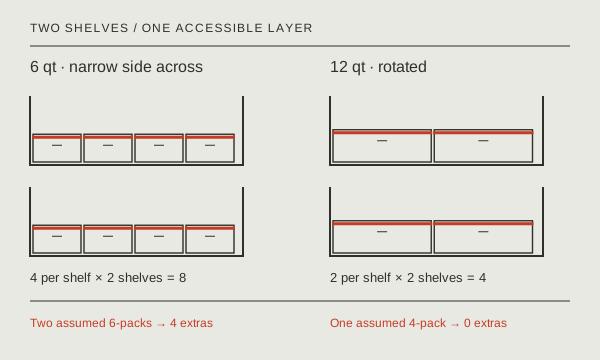
Two shelves and two bin sizes
Example setup: two shelf openings, each 35.5 inches wide, 15 inches deep, and 11.5 inches high. The plan uses one front row and one layer so each bin can be removed on its own. Allow half an inch at the outer edges and between bins on every axis. Shelf measurements and prices in this exercise are sample inputs.
The bin dimensions come from Sterilite’s model 2242 and 2243 product pages, checked on October 16, 2026. Match those model numbers when shopping. A quart capacity alone will not tell you whether another container fits this arrangement.
| Model | Nominal capacity | Outside | Inside at bottom |
|---|---|---|---|
| Sterilite 2242 | 6 qt | 13.5 × 8 × 4.625 | 11.5 × 6 × 4.25 |
| Sterilite 2243 | 12 qt | 16.375 × 11.25 × 5.375 | 13.875 × 9.125 × 4.75 |
Four small bins across each shelf
Place the 6-quart bin with its 8-inch side across the shelf and its 13.5-inch side pointing back. Four bins need 4 × 8 + 5 × 0.5 = 34.5 inches of width. There are five clearance gaps: one at each end and three between bins. One row needs 13.5 + 2 × 0.5 = 14.5 inches of depth. One layer needs 4.625 + 1 = 5.625 inches of height.
That gives four independently accessible bins per shelf, or eight across both shelves. This is the purchase target for this project.
The calculator also shows room for two layers: 2 × 4.625 + 3 × 0.5 = 10.75 inches. That gives eight bins per shelf geometrically, but the upper row would need moving to reach the lower row. For independent access, use four per shelf and eight total. Any stacked arrangement also needs a load and stability check.
The larger bin fits when turned sideways
With its 11.25-inch side across and 16.375-inch side pointing back, the 12-quart bin fails the depth check: 16.375 + 1 = 17.375 inches exceeds the 15-inch opening. Rotate it 90 degrees so the 16.375-inch side runs across the shelf.
Two rotated bins need 2 × 16.375 + 3 × 0.5 = 34.25 inches of width. Depth becomes 11.25 + 1 = 12.25 inches; one-layer height is 5.375 + 1 = 6.375 inches. The result is two bins per shelf, four for both shelves. Two layers would need 12.25 inches of height and would not fit.
Both choices have a nominal 48-quart capacity: eight times six or four times twelve. Their compartments differ. A rigid 12 × 8 × 4-inch item laid flat exceeds the small bin’s listed bottom dimensions but falls within the larger bin’s listed dimensions. Try the object in a sample to check the curved corners and closed lid.
How the pack size changes the bill
Sample offers: six small bins for $12, or four large bins for $20. These pack prices are inputs for the comparison, not current store quotes.
Eight small bins require ceil(8 ÷ 6) = two packs. You buy twelve, place eight, and have four left over. Four large bins require one four-pack. The lower per-bin price therefore produces the higher merchandise total for this particular arrangement.
Add shipping and tax before choosing the order. If you need only eight small bins, also price a six-pack plus two singles when the seller offers them. Four extras are worthwhile only if you have somewhere to use them.
| Option | Needed | Assumed pack | Buy | Extras | Merchandise |
|---|---|---|---|---|---|
| 6-quart bins | 8 | 6 for $12 | 2 packs · 12 bins | 4 | $24 |
| 12-quart bins | 4 | 4 for $20 | 1 pack · 4 bins | 0 | $20 |
Try one loaded bin before buying the set
Test removal with the door open, including the hinges, shelf lip, and room for your fingers. Load a sample with the intended contents and check the combined weight against the installed shelf’s rating. Follow the furniture maker’s anchoring instructions; CPSC’s Anchor It guide explains tip-over prevention.