In this guide
Will the contents fit inside?
Group the things you intend to keep in one bin. Measure the longest rigid item and the footprint of the whole group. Include folder tabs, shoe heels, bottle caps and anything else that projects. Decide whether the contents must stand upright; rotating a bottle or a file onto its side may defeat the intended use.
Compare that group with the inside bottom dimensions and usable height below the closed lid. Tapered walls, handle recesses and lid ribs can take away space. A capacity in quarts or liters does not describe the shape available to a rigid object.
| Candidate measurement | Finding | Decision |
|---|---|---|
| Outside: 11 × 8 × 5 in | Looks larger than the contents | Insufficient information |
| Inside bottom: 9.5 × 6.75 in | Too short and narrow | Reject for this flat box |
| Rotate the box 90° | Its 10-inch side would face the 6.75-inch dimension | Still fails |
| A larger candidate with a 10.5 × 7.5-in bottom and 4.5-in usable height | Dimensions clear the box | Test inserting and removing it before buying a set |
Can the closed bin reach the shelf?
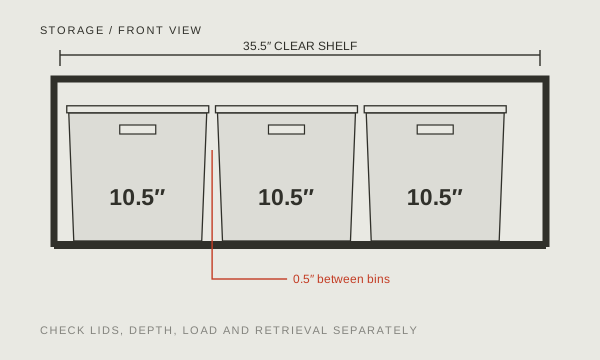
Measure the narrowest cabinet or doorway opening and the usable shelf space. Compare both with the maximum outside dimensions of the closed bin. In the width example, three 10.5-inch bins plus four half-inch gaps need 33.5 inches on a 35.5-inch shelf. Then check depth, height, and the route through the door.
If the door opening is narrower than the shelf, or the lid must open in place, use the clearance guide below. Keep those measurements separate from the interior-content test: a bin can pass one and fail the other.
How heavy is a full bin?
Weigh the representative contents and add the container and lid. Compare the total for every bin on the shelf with the rating for the actual shelf, supports and installation. Establish whether the manufacturer means one shelf or the entire unit, and whether its rating assumes an evenly distributed load. A concentrated stack and a correctly distributed load are different cases.
Example load: each bin weighs 2 pounds empty and holds 28 pounds of contents. Three loaded bins total 90 pounds. On a shelf rated for 100 pounds under that load arrangement, only 10 pounds remain for other items. A fourth bin raises the total to 120 pounds. Use the rating for your shelf and its installed supports.
Try lifting the loaded sample onto a nearby working surface. If it is awkward to grip or control, divide the contents between smaller bins. Store heavier items lower, as CPSC recommends, and anchor the furniture according to its instructions.
Can you get things out easily?
Put the loaded sample in its proposed position. Take out the item you use most often, put it back and return the bin. Repeat with the neighboring position occupied. This exposes handle access, a blocked label, a lid that needs a landing space, and a rear bin that requires unloading the front row.
Choose the correction that matches the failure. Use a shallower bin if small items disappear at the bottom; separate a heavy category if lifting is awkward; use an open-front container for frequently retrieved items if they do not need a closed lid. A removable divider can keep two small groups distinct without requiring two large bins.
For occasional storage, moving a front container may be acceptable. For daily supplies, count only the positions you can use at that frequency. Keep that usable count separate from the calculator’s three-dimensional maximum.
Buy the tested quantity
Order the remaining containers only after the sample passes the content, route, handling and shelf-load checks. Include the sample you already own when calculating how many more you need. Compare packs on the total you must pay, with lids and delivery included where applicable.
Save the model or item number and the dimensions you measured. A similar-looking replacement can have a different lid, taper or handle. Label the contents on the side visible in the final arrangement.