Check whether a heated drying cycle is actually running. Air-only settings, cooldown and some energy-saving phases tumble without heat. If a conventional dryer stays cold during its approved heat check, follow the electric or gas branch below. If it warms but leaves laundry damp, investigate drying performance. Heat-pump models need their own warm-up rules.
In this answer
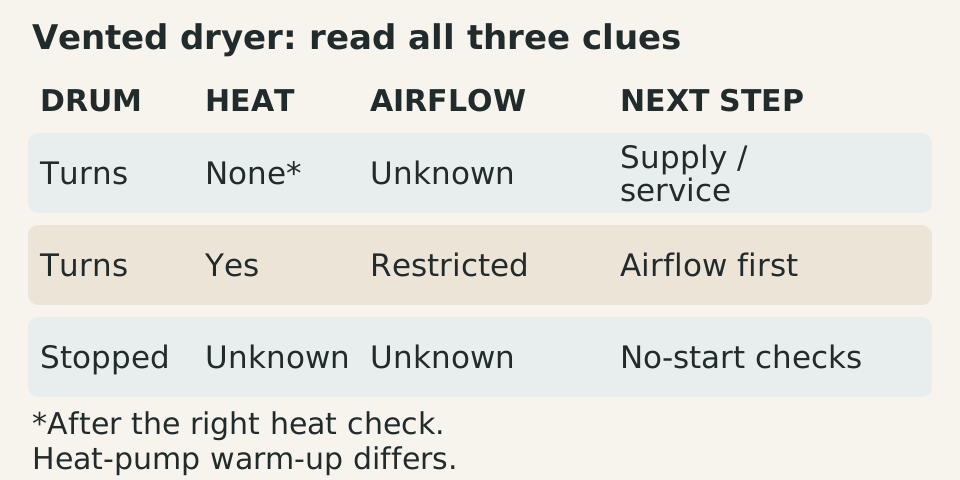
Enlarge diagram
Swipe across to see the rest of the diagram.
Before running a test
Do not test a dryer with smoke, a burning smell, unusual overheating, a damaged cord or a visibly crushed or disconnected exhaust. Stop using it and arrange the appropriate repair. For smoke or fire, leave and call 911. If you smell gas or suspect a gas leak, leave without touching switches, plugs or the dryer controls; call 911 and your gas utility from a safe distance.
For an otherwise safe machine, find the model number and its owner instructions. Identify conventional electric, gas or heat pump, and whether it vents outdoors. A phone for recording the display and a timer are enough for these checks; a multimeter and cabinet-opening tools are not needed. Clean and refit the accessible lint screen with the machine stopped and cool, following its care instructions.
Check the setting, then check for warmth
Clothes that feel cool after the program finishes do not prove the dryer never heated. Check the cycle stage and selected temperature before changing anything. On some LG models, Energy Saver includes substantial unheated tumbling; switch it off for one comparison only if the model’s instructions allow it.
- Read the controls. Air Only or Air Fluff is an intentional no-heat choice. Select a heated drying program suited to the fabric, rather than a fluff or cooldown setting.
- Use the manufacturer’s heat-check procedure for your model. Whirlpool’s conventional-dryer support procedure calls for an empty drum on a heated timed cycle for five minutes. Keep the exhaust connected and lint screen fitted. This procedure is not a heat-pump test.
- At the end of that check, stop the dryer, wait for the drum to stop, and open the door to check for warmth inside without touching hot metal. Record “warm” or “still cool,” the selected cycle, and any displayed code. Other manufacturers’ tests and warm-up times can differ.
Put running, heat and airflow together
The table chooses the next investigation; it does not identify a failed part. “Airflow unknown” is a useful result when the outdoor outlet is inaccessible. Heat-pump dryers have internal airflow and usually no outdoor exhaust to inspect.
For a vented machine, inspect only what you can see without moving a gas dryer, unstacking equipment or climbing. If a heat check is safe, observe a ground-accessible outdoor flap while the dryer runs. A closed flap or visible crushing calls for attention; an open flap does not measure adequate airflow. Do not disconnect the duct and exhaust into the room to test it.
Scroll across to read every column.
| Drum operation | Heat observation | Airflow clue | Next action |
|---|---|---|---|
| Does not turn | Not established | Not established | Use the model’s no-start checks; this is not yet a heating-only fault. |
| Turns normally | Still cool after the applicable heated check | No obvious obstruction, or unknown | Follow the electric, gas or heat-pump branch. Air movement alone does not prove heating works. |
| Turns normally | Warms, but laundry stays damp | Closed outdoor flap, crushed connector or airflow alert | Stop repeated cycles and have the exhaust restriction assessed. |
| Turns normally | Warms, but laundry stays damp | No obvious airflow warning | Check load size, fabric mix, washer spin and early sensor stopping in the linked drying-performance guide. |
| Turns normally | Starts warm, then stays cool before drying is complete | Any | Record the cycle stage and settings. If the change is unexplained and drying remains poor, arrange service. |
Electric: a spinning drum does not confirm full power
On the conventional GE electric dryers covered by its no-heat guidance, the motor may run with only 120 volts available while heating requires the specified 208- or 240-volt supply. The light and drum working therefore do not rule out a supply problem.
Look at the installation history: did the trouble start after a move, cord replacement, electrical work or an outage? If the correctly labeled dryer breaker is safely accessible, note its visible position without removing any panel cover. A normal-looking handle does not prove the supply is sound. Do not repeatedly reset a tripping breaker, change its rating, probe the outlet or open the dryer’s terminal cover.
Have an electrician check a suspected supply or outlet problem; ask the installer to verify a recent installation. If the supply is confirmed correct and the heated check stays cold, arrange appliance service. Do not buy a heating element solely because the drum turns.
Gas: confirm the supply history without doing gas work
A gas dryer still needs electricity to turn the drum. That movement does not confirm that fuel is reaching the burner. For a newly installed machine, ask the installer whether the gas connection and startup were completed. Check for a known utility interruption or a shutoff left closed during recent work.
You may note the position of a clearly identified, readily visible appliance valve, but do not move the dryer or turn an unfamiliar or unexplained closed valve. Have the installer or qualified service provider resolve it. If supply is confirmed available and the dryer still runs cold, book service. Burner, igniter, gas-valve and fuel-conversion work are outside these checks; never use a flame to test for gas.
Heat pump: use its own warm-up and supply requirements
A heat-pump dryer can dry at lower temperatures than a conventional dryer. Whirlpool’s compact heat-pump troubleshooting page specifically says its covered Timed Dry cycle does not begin heating until 20 minutes into the cycle, and then uses light heat. A five-minute check would give the wrong impression. This is an example of a product-specific delay, not a waiting time to apply to every dryer.
Use the program recommended for the load and check the model’s listed filters, tank or drain alerts. Clean only owner-serviceable filters by their specified method and refit them correctly. Do not assume a heat exchanger can be removed or rinsed. Compare the next suitable load with this machine’s usual drying result, not how hot your previous dryer felt.
Electrical requirements also vary: Whirlpool’s compact guidance describes a 240-volt supply, while the GE Profile UltraFast heat-pump washer-dryer combo uses a dedicated 120-volt outlet. Match the full model to its installation instructions. Persistent poor drying or an unresolved alert after the applicable care calls for service; leave compressor and refrigerant-system work to qualified technicians.
Confirm the change, or make the service call useful
If correcting a setting restores warmth and there are no safety or airflow concerns, run the next normal load on its fabric-appropriate program. Keep the fabric mix, load size and washer spin similar to your usual routine. Success means the load reaches its expected dryness without new alerts, abnormal heat or another full drying cycle. Brief warmth alone is not proof of a complete repair.
If the dryer stays cold on the correct model-specific check, or unexplained heat loss and poor drying continue after checking the cycle and settings, stop experimenting and share the observations below when booking service. Internal heaters, wiring, thermal cutoffs and controls need model-specific diagnosis. Never bridge a thermal fuse, bypass a door switch or run with protective panels removed.
Have the model and observations ready for service.
Make an appliance recordSources
- Whirlpool: Dryer is Not Heating ↗
No-heat settings and the five-minute empty heated-cycle check for conventional dryers. This timing does not apply to heat-pump models.
- GE Appliances: Electric Dryer - Runs But Does Not Heat ↗
Partial-power explanation and specified 208/240 V supply for the covered conventional electric dryers.
- GE Appliances: Gas Dryer - Runs But Does Not Heat ↗
Heated settings, gas availability after installation, and service when a dryer with gas supply still runs cold.
- LG USA: LG Dryer – Why is My Dryer Not Heating, Not Drying or Taking a Long Time Drying? ↗
Energy Saver behavior and installation-test guidance with different controls by model; test codes are not universal part diagnoses.
- Whirlpool: Not Heating - Compact Heat Pump Dryer ↗
Lower-temperature drying, a stated 20-minute Timed Dry heating delay, filter care and 240 V supply in the covered compact heat-pump category.
- GE Appliances: GE Profile UltraFast Combo Washer/Dryer - Installation ↗
The GE Profile UltraFast Combo uses a dedicated 120 V outlet and ventless heat-pump drying. Requirements differ from conventional electric dryers.
- U.S. Fire Administration: Clothes Dryer Fire Safety ↗
Lint-filter care, visible exhaust restrictions, outdoor cover operation and professional installation/service.
- PG&E: Gas safety ↗
Suspected natural-gas leaks: leave, avoid ignition sources and call for help from a safe distance. Contact your own gas utility.
- GE Appliances: Dryer - Taking Too Long To Dry Clothes or Not Drying at All ↗
How load size, fabrics, washer extraction and exhaust condition affect drying performance.