In this guide
Start with the same finished job
Write a common scope for the quotes: surfaces or dimensions, preparation, exact material selection, finish, removal, disposal, delivery, and any required specialist work. Identify what is already included in a line and what is separate. Keep the original quote beside the comparison sheet so simplifying a label does not erase a condition.
The FTC recommends written estimates identifying the work, materials, completion date, and price. Keep those details on the comparison sheet. The example below uses sample prices and contractor-supplied tax amounts to show the arithmetic.
How is the allowance adjusted?
An allowance reserves an amount for an item that has not been fully priced or chosen. Record the allowance's amount, covered quantity, included services, and treatment of overages and credits. 'Materials: $600 allowance' is not equivalent to a fixed price for a named material list unless the contractor confirms that interpretation.
In this example, quote A allows $600 for materials. The final selections cost $780 for the same quantity, an increase of $180. A stated 10% fee on that increase adds $18. Ask each contractor how overages, credits, and fees work before entering those adjustments on your own sheet.
Is tax already in the headline price?
Suppose A's quoted total is $3,200 and explicitly includes $96 of tax. Quote B shows a $3,500 subtotal and separately states $110 of tax. Comparing $3,200 with $3,500 mixes tax-inclusive and tax-exclusive figures before addressing any scope differences.
Choose one accounting convention. Either compare pre-tax rows and add tax once, or start with each quoted contract total and add only confirmed changes. This example uses the second approach. A's original $96 is already inside $3,200 and must not be added again. B's $110 has not yet been included and must be added once.
| Item | Quote A | Quote B |
|---|---|---|
| Headline amount | $3,200 total | $3,500 subtotal |
| Tax already in that amount | $96 included | No; $110 stated separately |
| Selected materials | $600 allowance | Selected $780 list included |
| Disposal | Excluded | Included |
| Concealed substrate repairs | Unpriced | Unpriced |
Reconcile the two totals
Add $180 for A’s material overage and $18 for the fee. Its disposal charge adds $140 including tax. The material-and-fee adjustment adds a further $22 of tax supplied by the contractor. Keep that $22 adjustment separate from the $96 already included in A’s quote.
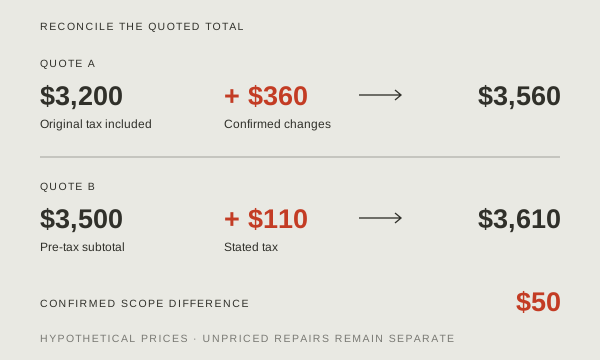
A's comparable total is $3,200 + $180 + $18 + $140 + $22 = $3,560. B already includes the selected materials and disposal, so its comparable total is $3,500 + $110 = $3,610. A is $50 lower for the confirmed common scope. The headline difference was $300; it did not represent the final comparable difference.
| Adjustment | Quote A | Quote B |
|---|---|---|
| Starting quoted amount | $3,200 | $3,500 |
| Material allowance difference | +$180 | Included |
| Agreed fee on that difference | +$18 | Included |
| Disposal add-on, with its tax | +$140 | Included |
| Tax still to add | +$22 adjustment only | +$110 |
| Comparable confirmed total | $3,560 | $3,610 |
What if repairs are still unpriced?
Both quotes leave concealed substrate repairs unpriced. Ask what finding would trigger a repair, who will inspect it, how the quantity will be measured, and how the price will be agreed. Record the answers beside the total so that the unresolved work stays visible.
Use “included” when the quote covers the work, “excluded—priced separately” when you have an additional price, and “unpriced” when you are still waiting for one. Keep unpriced items out of a final ranking until you know whether both contractors are allowing for the same work.
Get the change process in writing: work description, quantity, price, effect on completion date, and approval before the extra work begins.
The cash reserve and payment dates
Holding a $400 reserve gives you cash budgets of $3,960 for A and $4,010 for B. The $50 difference stays the same. Keep the reserve below the quote total as money set aside for changes; agree a price before authorizing any additional repair.
Put deposits and later payments on a timeline with the work or delivery each payment covers. Check that the installments add up to the accepted contract amount. This shows whether the lower-cost option requires more cash earlier.
| Budget line | Quote A | Quote B |
|---|---|---|
| Confirmed comparable work | $3,560 | $3,610 |
| Owner-selected reserve | $400 | $400 |
| Planning cash amount | $3,960 | $4,010 |
| Unpriced repairs | Still unresolved | Still unresolved |
Trace each addition to its source
Read the reconciliation from top to bottom and trace every added amount to a written clarification. In this example, adding A's original $96 tax again would wrongly raise its comparable total to $3,656. Adding B's included disposal as a new charge would create a different error. The words 'included,' 'allowance,' and 'subtotal' matter as much as the digits.
Save the common scope, material selection, updated tax information, allowance treatment, and change process with the quote. If a later selection changes, revise the affected lines and date the sheet rather than adding an unexplained buffer to the total.