In this guide
Give both contractors the same brief
Write one brief for the job and give the same version to each contractor. Include location, dimensions, selected products, finish, existing conditions, and the work you expect to be completed. Attach photographs or a marked drawing where they clarify the scope. Date any revision.
The Federal Trade Commission recommends multiple written estimates and questions about large price differences. Check licensing with the relevant state or local authority and request proof of insurance. Keep that information with the written scope so you can compare both the contractor and the proposed job.
What is included in each price?
Create a row for each substantial part of the job: preparation, materials, installation, finish, removal, disposal, delivery, access equipment, and cleanup. Add permits or inspections where the project requires them. Mark each row included, excluded, allowance, or unclear. Use the contractor's own wording alongside your normalized description so you do not erase an important difference.
Check quantity units. A quote for 100 linear feet cannot be compared directly with one for 80 linear feet. Likewise, square footage of painted surface is different from room floor area. Ask how the contractor measured the quantity and what its unit price includes. Some work has a fixed mobilization cost, so dividing the entire total by area can be misleading.
What does an allowance cover?
An allowance is a placeholder amount for an item whose selection or final cost is not settled. Record what the allowance covers, the quantity assumed, and how an overage or credit will be calculated. A $300 material allowance may mean something different from a $300 supply-and-install allowance.
An exclusion may be work you intend to handle yourself or hire separately. Mark who will do it and where its cost belongs. For an unclear item, ask a specific written question: 'Does this amount include hauling away the removed trim?' Keep the answer with the quote.
The cheaper headline price can cost more
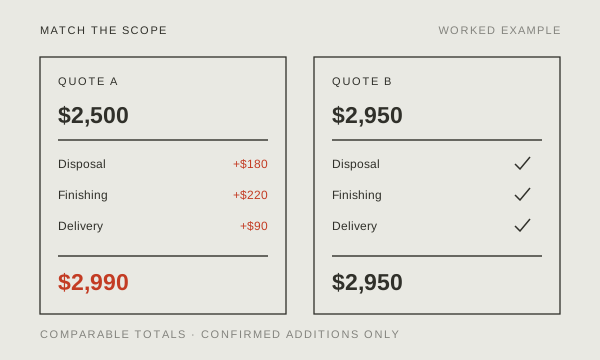
Sample quote comparison: A is $2,500, plus $180 for disposal, $220 for finish work, and $90 for delivery. Those additions bring it to $2,990. B is $2,950 with the same items included. A’s apparent $450 saving becomes a $40 higher total. These sample amounts illustrate the calculation; use written prices for your own comparison.
If those three additions have not been priced, write “$2,500 plus disposal, finish, and delivery” beside A. Ask for each missing amount. Leave the total unresolved until the replies arrive.
Payment dates and changes
Look for start and completion expectations, site access, responsibility for protecting adjacent surfaces, cleanup, payment milestones, and how changes will be authorized. Clarify who decides that a milestone is complete and how a hidden-condition issue will be documented. A short written change request should identify the work, price effect, and schedule effect before the extra work proceeds.
The FTC cautions against paying the full project amount in advance. Check deposit and contract requirements with your local consumer protection agency, then put each payment amount and its milestone in the agreement.
Before accepting a quote
With the scope clarified, compare the remaining differences: selected products, workmanship details, availability, communication, and references you can check. Ask what could change the price. If hidden substrate repairs will be priced after exposure, the agreement should describe how the added work will be documented and approved.
Keep the accepted scope, product selections, written clarifications, and changes in one folder. Label revised quotes by date. Before signing, read back the lines that are easy to misremember: preparation, primer, finish coats, installation, and cleanup.