In this guide
Are the two deck quotes for the same job?
Put the same deck in both columns: area, shape, stairs, railing, fascia, demolition, disposal, access, and finish. Separate optional accessories. If one number is for surface boards and the other is an installed quote, obtain the missing scope before comparing totals.
Choose a period that matches how long you expect to use the deck: ten years for this comparison, or twenty if that suits your plans. Keep the expected care schedule alongside it. A product warranty is useful to read, but it is not a replacement schedule.
Deck boards and framing costs
Separate decking surface costs from the supporting structure and other components. Composite and wood options may require different approved fasteners, spacing, or supporting details. A reused frame should be assessed for condition and compatibility; choosing a new surface material does not establish that the old structure is suitable.
Use current supplier prices or comparable contractor quotes. Treat taxes and delivery consistently. If a quote is missing railing or removal, ask for that price and record the answer. Save the date and scope with each quote so you can tell later whether a revised number covers the same work.
What upkeep belongs in the comparison?
Use separate rows for routine cleaning, periodic refinishing, and any specific repairs you choose to model. For each row, record the year, expected cash cost, and optional hours of your own time. Keep assumptions you can revisit. A coating interval should come from the chosen finish, exposure, and its condition, not an unsupported universal promise.
Include routine cleaning for composite too. Trex’s care guide groups products by generation because their cleaning directions differ. Find the product family before choosing a cleaner or pressure-washing method, and price the supplies and time that its care routine needs.
A ten-year cost example
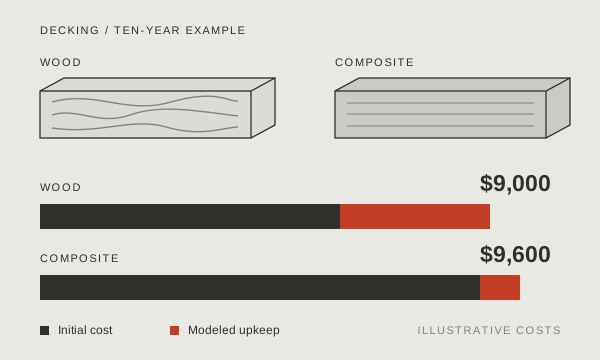
Example budget, using sample prices rather than retail quotes: $6,000 installed for wood and $8,800 for composite. Wood gets $120 of annual care plus a $600 refinishing payment in years 3, 6, and 9. Composite gets $80 of annual care.
Across years 1 through 10, wood totals $6,000 + 10 × $120 + 3 × $600 = $9,000. Composite totals $8,800 + 10 × $80 = $9,600. Wood costs $600 less in this scenario. This cash comparison leaves out inflation, financing, discounting, resale value, and unplanned repairs.
When does composite become cheaper?
If each modeled wood refinishing event costs $900 instead of $600, the ten-year wood total becomes $9,900. Composite is then $300 lower. A $300 change in three future events reverses the result, which tells you that obtaining a credible maintenance assumption matters more than adding extra decimal places.
The table keeps the refinishing payments in their actual modeled years. In the $900 scenario, wood is still cheaper at year 8, but the year-9 event takes its cumulative cost above composite. There is no crossover in the ten-year $600 scenario. Dividing the initial gap by an annual average would hide that payment date.
| Year | Wood: $600 events | Wood: $900 events | Composite |
|---|---|---|---|
| 0 | $6,000 | $6,000 | $8,800 |
| 3 | $6,960 | $7,260 | $9,040 |
| 6 | $7,920 | $8,520 | $9,280 |
| 8 | $8,160 | $8,760 | $9,440 |
| 9 | $8,880 | $9,780 | $9,520 |
| 10 | $9,000 | $9,900 | $9,600 |
Costs the table does not capture
List the differences you care about beside the cost columns: appearance, feel, cleaning effort, repairability, and the disruption of refinishing. If you price your own labor, show those hours and the assumed rate separately from cash spending. Leave resale value out unless you have a defensible basis for including it.
Handle samples of both materials in the intended setting and compare their cleaning and installation requirements. If you want to retain the frame, arrange a condition and compatibility assessment before ordering the new boards. A required frame repair belongs in the initial cost column.
Use annual averages for budgeting
To reproduce the $600-event scenario’s ten-year total in the calculator, enter $300 annual wood maintenance: $120 routine care + ($1,800 ÷ 10). Enter $80 for composite. For the $900-event scenario, wood’s annual budgeting average is $390. Use the same initial costs as above; enter installation consistently so it is not counted twice.
These annual averages reproduce the totals at year 10 only. The calculator charges a constant amount each year, so its crossover year does not reproduce the dated refinishing schedule in the table. Keep the dated schedule when deciding when cash must be available.