In this guide
The required quantity and the price assumptions
Worked example: one purchase group — the same product, color and sheen — needs 6.1 US gallons after area, coats and the chosen waste allowance. The container prices are hypothetical: $40 per one-gallon can and $150 per five-gallon pail. They are not the prices of any named product. Write down your actual local container prices before repeating this; sample prices only demonstrate the method.
Coverage is a per-product figure read from the label of the paint you intend to buy, not a universal guarantee. Labels state ranges that depend on surface texture, porosity and application method, so the 6.1-gallon requirement is an estimate built from your inputs.
The comparison below covers paint containers only. Taxes, shipping, primer, trim paint, and labor are excluded. A price you have not entered is unknown, not zero: a missing five-gallon price cannot make the pail look free or cheap.
Enlarge diagram
Swipe across to see the rest of the diagram.
Enumerating the eligible combinations
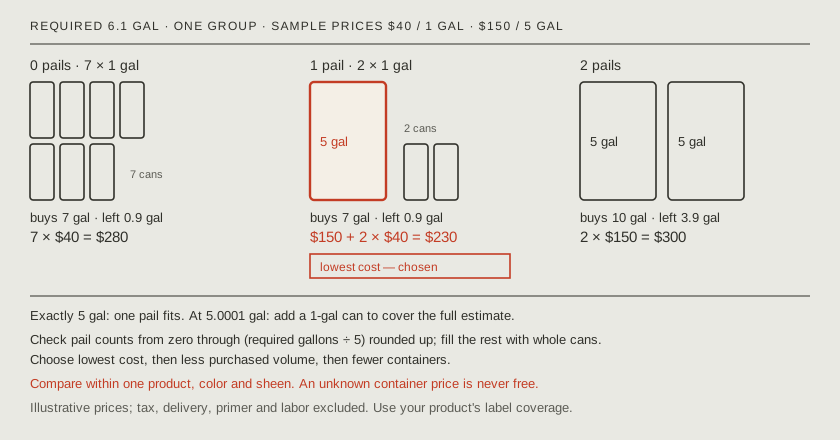
For a 6.1-gallon requirement, the useful five-gallon counts are zero, one, and two. The planner checks every count from zero up to the smallest whole number of pails that could cover the requirement — for 6.1 gallons that is 6.1 ÷ 5 = 1.22, rounded up to 2 pails — because anything beyond that only adds cost. Each row must buy at least the required quantity within one group — containers of the same product and color can be pooled, containers of different groups cannot.
With zero pails, seven one-gallon cans are needed: 7 × $40 = $280, buying 7 gallons with 0.9 gallon left over. With one pail, 6.1 − 5 = 1.1 gallons remain, so two one-gallon cans are added: $150 + 2 × $40 = $230, buying 7 gallons with 0.9 gallon left. With two pails, 10 gallons cost $300 and 3.9 gallons are left over.
The minimum cost is $230. If two combinations had tied on cost, the tie would break to the less purchased volume, then to the fewer containers. At these prices no tie arises, but the rule makes the choice deterministic when prices differ by a cent or not at all.
Scroll across to read every column.
| Five-gallon pails | One-gallon cans | Gallons bought | Leftover | Cost |
|---|---|---|---|---|
| 0 | 7 | 7 | 0.9 gal | $280 |
| 1 | 2 | 7 | 0.9 gal | $230 |
| 2 | 0 | 10 | 3.9 gal | $300 |
When the pail wins, and when it does not
The pail wins when the per-gallon saving outweighs the cost of the leftover paint. In the two-rooms example on this site, a shared group needs 3.41 gallons. One five-gallon pail costs $150 and leaves 1.59 gallon; four one-gallon cans cost $160 and leave 0.59 gallon. The pail is $10 cheaper here despite leaving a gallon more on the shelf.
That comparison exists only within one group. Never pool different colors, products or sheens to reach a container threshold; a five-gallon pail is a single color, and surplus of the wrong color cannot cover any wall.
The pail does not always win. For a group needing 1.76 gallons, two one-gallon cans cost 2 × $40 = $80 with 0.24 gallon left, while the five-gallon pail costs $150 with 3.24 gallons left: the pail is $70 more expensive here. The 3.41-gallon comparison above is therefore not a universal recommendation — run the enumeration for your own required quantity and prices.
Leftover paint has some value for touch-ups and a second room, but plan the purchase on cost and coverage, and record what you actually used afterwards so the next estimate improves.
Exact fits, 5.0001 gallons, and estimate precision
At exactly 5.0000 gallons required, one five-gallon pail fits and no one-gallon cans are added. At 5.0001 gallons it does not: a single pail covers only 5 of the required 5.0001 gallons, so the purchase becomes one pail plus one one-gallon can. The boundary is exact, and it is purely mathematical — the purchased containers must cover the whole unrounded estimate, however small the excess is.
This is why the purchase decision uses the unrounded required quantity. A result displayed as ‘5.0 gallons’ may stand for 5.04 or 4.97; re-using a rounded display value in the container arithmetic can leave the purchased quantity short of the estimate. Keep full precision through the comparison and round only when counting containers.
Because the required gallons come from your measured areas and an assumed coverage, treat a result that sits within a few hundredths of a container boundary as a signal to check inputs — the coverage range on the label, the waste allowance, the openings you subtracted — before trusting the cheaper row.
Using the decision figure
The planner’s per-group result is a purchase decision, not a decoration: for each group it shows required gallons, the ‘1-gallon only’ cost, the lowest-cost one- and five-gallon mix with its leftover quantity, and the price assumptions you entered. Those are the numbers to carry to the paint counter, next to the product, color code and sheen.
A blank container price is excluded from the price comparison rather than treated as free. As long as one container size has a price, the purchase can still be calculated; if all container prices for a group are blank, the planner shows the required gallons with the cost left as unknown. Fill in the prices from the store you will actually buy from, since container pricing differs by retailer, product line and region.
After painting, compare the containers used with the containers bought. If a group consistently leaves more than you will ever use for touch-up, the next estimate can start from a smaller waste allowance or a different package choice.