In this guide
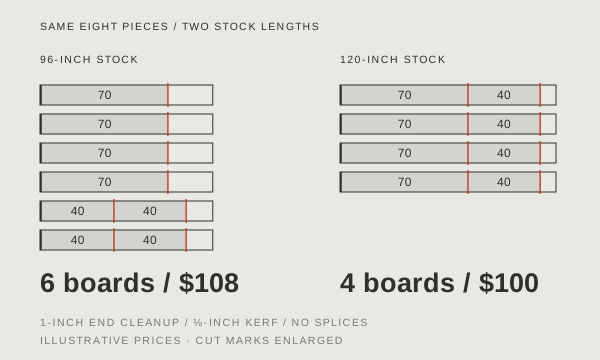
The cut list: four long pieces and four short ones
The job needs four 70-inch pieces and four 40-inch pieces of one profile, all in continuous lengths. That is (4 × 70) + (4 × 40) = 440 finished inches. Keep this list fixed while comparing the available boards.
If your list contains different profiles, thicknesses, species, grades, or finishes, compare each group separately. Check whether the measurements describe finished square-cut lengths, miter long points, or another reference. This worksheet uses square-ended pieces. Angled ends, damaged sections, or a grain requirement can invalidate an arrangement that fits by length alone.
Allow for kerf and end cleanup
Use one set of cutting allowances for both stock options. This manual example reserves 1 inch per board for squaring the ends and charges a 0.125-inch kerf for every finished piece. The 1-inch reserve already includes the end cuts.
A 96-inch board leaves 95 usable inches and a 120-inch board leaves 119. Eight finished pieces use another 8 × 0.125 = 1 inch in kerf. Before making your own cutting plan, check the blade specification: DEWALT’s DW3103, for example, lists a 0.095-inch kerf on its Australian product page, smaller than this worksheet’s 1/8-inch allowance.
To reproduce a total end-cleanup allowance of 1 inch per board in the cut-list planner, enter 0.5 inch in “Trim at EACH end.” That reserve includes the material removed while squaring the ends.
Why the eight-foot plan needs six boards
A 70-inch piece uses 70.125 inches including its assigned cut. The remainder of a 95-inch usable board is 24.875 inches, too short for a 40-inch piece. Two 70-inch pieces also cannot share that board. All four long pieces therefore require their own boards.
The four 40-inch pieces fit two per board: 40 + 40 + (2 × 0.125) = 80.25 inches, leaving 14.75 usable inches on each of two additional boards. The total is six boards. Dividing the 441 inches of finished pieces plus kerf by 95 gives a lower bound of five, but no five-board arrangement can meet these piece lengths without splicing.
| Boards | Assigned pieces | Used incl. kerf | Usable offcut each |
|---|---|---|---|
| 1–4 | One 70-inch piece each | 70.125 in | 24.875 in |
| 5–6 | Two 40-inch pieces each | 80.25 in | 14.75 in |
Why four ten-foot boards work
On each 119-inch usable board, pair one 70-inch piece with one 40-inch piece. The pair uses 70 + 40 + (2 × 0.125) = 110.25 inches, leaving 8.75 inches. Repeat that arrangement four times. Every required piece is present and none has a splice.
Three ten-foot boards offer only 357 usable inches, short of the required 441. Four is the minimum for this piece list and these cutting allowances.
| Boards | Assigned pieces | Used incl. kerf | Usable offcut each |
|---|---|---|---|
| 1–4 | 70 + 40 inches | 110.25 in | 8.75 in |
Which order is cheaper at checkout?
Sample prices: $18 for an eight-foot board and $25 for a ten-foot board. The shorter board costs $2.25 per linear foot, against $2.50 for the longer one. Yet the complete orders are 6 × $18 = $108 and 4 × $25 = $100. The higher per-foot price saves $8 on this job.
Check whether longer stock changes delivery, vehicle rental, or handling costs. If only the ten-foot order needs an additional $12 transport charge, its total becomes $112, which is $4 above the $108 alternative. Apply tax consistently, and include any different minimum-order or cutting-service charges before choosing. Confirm that the full stock length can reach the work area without an unplanned cut.
| Option | Price per foot | Required order | Board cost | With extra transport |
|---|---|---|---|---|
| 8-foot stock | $2.25 | 6 × $18 | $108 | $108 |
| 10-foot stock | $2.50 | 4 × $25 | $100 | $112 if a $12 charge applies |
Which offcuts will you actually use?
The eight-foot plan buys 576 inches. After 440 inches of finished pieces, 1 inch of kerf, and 6 inches of reserved end cleanup, 129 usable offcut inches remain. The ten-foot plan buys 480 inches, with 35 usable offcut inches remaining after the same finished pieces, 1 inch of kerf, and 4 inches of cleanup.
Write down the individual offcut lengths alongside the totals. Four 24.875-inch pieces may supply another item on your cut list, while four 8.75-inch pieces may be too short. Count a saving only if an offcut replaces something you would otherwise buy.
What to take to the supplier
Bring the board assignments and price comparison to the supplier. Check the profile, condition, and usable length before accepting a substitute. Mark the pieces that must remain continuous. A board shorter than one of those pieces needs a different stock option or a revised design.
For this example, a mixed order is possible but is not needed to establish the comparison: four 70-inch pieces each require their own board under either offered length, and pairing each with a 40-inch piece gives the four-board plan. For a different list, compare mixed lengths as well as all-short and all-long orders.