Record the slide system, usable mounting space and drawer-box dimensions before choosing a replacement. A nominal length on a listing is only one part of the fit.
In this answer
1. Identify the system while it is still assembled
This is a measuring and ordering guide. It does not assume that a sticking drawer needs new slides. If the box is damaged or the mounting surface has moved, replacing the hardware may leave the same fault.
Empty the drawer. Photograph the left and right fittings, the front attachments and the rear support. Note any stamped numbers on both sides and any separate locking devices or brackets. Record whether the cabinet has a front face frame or an open, frameless box.
Remove the drawer only by the release procedure for that system, supporting its weight. If it does not release as expected, stop and identify it. Do not use a forceful pull to discover whether a disconnect exists.
Scroll across to read every column.
| System to identify | Measurements to collect | Common shortcut to avoid |
|---|---|---|
| Slides beside the drawer box | Box width, spacing between slide mounting faces, left and right side spaces, length and mounting height. | Assuming every side-mount slide needs the same clearance. |
| Concealed runners below the box | Inside and outside box widths, side thickness, bottom recess, rear preparation and locking-device codes. | Applying a side-mount width deduction to an undermount system. |
| Center runner, roller system or proprietary metal drawer | Exact system code and the dimensions identified by its manufacturer. | Buying a visually similar ball-bearing pair by length alone. |
Enlarge diagram
Swipe across to see the rest of the diagram.
2. Give each length its own name
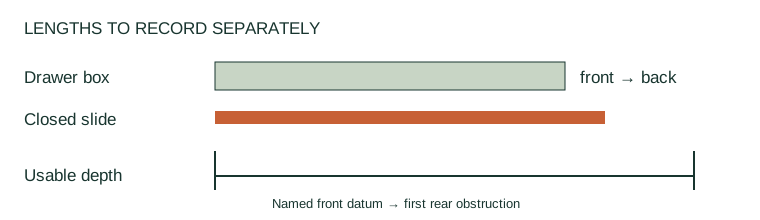
Record the existing slide's closed overall length, the drawer-box length from front to back, and the cabinet's usable depth. Measure the box itself, excluding an applied decorative front. Note any rear protrusion separately. Photograph where each ruler starts and ends.
At the cabinet, record your starting reference: the cabinet face, the back of a face frame, or the proposed slide mounting position. These are different datums. Measure to the first obstruction along the hardware's path, not simply the outside back of the cabinet. Keep left and right readings if the available spaces differ.
For example, Accuride's 3832-C18EC table lists a closed slide length of 17.72 inches (450 mm) and travel of 18.00 inches (457 mm). Travel and physical length are separate columns. Do not round a measured length up to a retail size and assume it fits.
3. Measure width where the slides actually mount
For a side-mounted pair, measure between the two intended mounting faces at the front, middle and rear of the slide path. On a face-frame cabinet, also record the clear front opening and any blocking behind it. The cabinet's overall outside width does not answer either question.
Measure the drawer box's outside width at the corresponding positions. Then record the actual available space on the left and right, where accessible, with the box in its intended position. Do not force a gauge into an installed slide. If access prevents a reliable measurement, mark the field “unknown.”
Opening width minus box width gives the total side space. Dividing by two gives an average only. It does not demonstrate that the box is centered, that the sides are parallel, or that both gaps remain consistent along the slide.
Accuride's installation guidance calls for parallel slides and correct, consistent side space, with the applicable product sheet controlling the dimensions. Record a narrow point as well as the average. A measurement mismatch is something to resolve before ordering, not something to hide by rounding.
4. Compare the measurements with one exact model
For the 3832EC, Accuride specifies side space per side of 0.50 inches with +0.031/−0.0 tolerance (12.7 mm +0.8/0.0), and recommends a box 1-1/16 inches narrower than the opening for optimal performance. It is a side-mount product; the sheet also limits drawer width relative to slide length. These are not universal dimensions for all ball-bearing slides.
Hypothetical measurement example: the mounting faces are 500.0 mm apart and the drawer box is 474.6 mm wide. The total space is 25.4 mm, so dividing by two gives an average of 12.7 mm. But suppose the measured gaps at one matching cross-section are 12.0 mm on the left and 13.4 mm on the right. The left side is below this model’s minimum even though the average equals it.
Record the actual gaps at the front, middle and rear rather than using the average as a pass. This example is a dimensional check, not an installation trial or a recommendation to shave or shim the box. The sheet’s preferred 27.0 mm total deduction, length, parallel mounting, width and other requirements still need separate checks.
Scroll across to read every column.
| Check | Calculation or measurement | Finding |
|---|---|---|
| Total side space | 500.0 − 474.6 = 25.4 mm | A total does not locate the drawer within the opening. |
| Average per side | 25.4 ÷ 2 = 12.7 mm | Not a substitute for either actual gap. |
| Measured left / right | 12.0 / 13.4 mm | Left is below the specified 12.7 mm minimum. |
| Other cross-sections and requirements | Not measured in this example | Compatibility is not established. |
5. Treat undermount dimensions as a separate system
Blum's TANDEM 563H/563. instructions relate inside drawer width to the opening and account for drawer-side thickness when calculating outside width. They also specify bottom geometry, rear preparation and compatible locking devices. Use that system's drawing rather than carrying over a half-inch side gap.
In the manual's frameless application, 563H5330B is shown with a 533 mm drawer, a 548 mm runner and 557 mm minimum inside cabinet depth. These three numbers describe different things.
Illustrative depth check: a measured 552 mm usable depth is longer than that runner but 5 mm short of the specified cabinet minimum. The runner's metal length alone would give the wrong answer. This comparison assumes the same front datum and application as the drawing. Inset fronts and different rear attachments require their own diagrams.
6. Check what the order actually includes
Before putting a candidate on your purchase list, complete a row for each of these checks:
Do not select screw length from the slide length or reuse existing screw holes automatically. Hole position and fastener requirements belong to the replacement model. Keep those questions visible if the seller's listing is incomplete.
Use page 2 of the hardware measurement worksheet for raw measurements and page 3 for candidate checks. The final status should be “candidate matches the recorded specifications,” “does not match,” or “needs confirmation.” A measurement sheet is not proof that a replacement has been installed and tested.
- Exact identity: complete model, length suffix, finish and left/right requirements.
- Fit: each measured dimension compared with the matching drawing; no unexplained “close enough” values.
- Mounting: usable fastening surfaces, required brackets or blocking, locking devices, front setback and rear space.
- Use: intended drawer width, load and mounting orientation checked against that model's rating conditions.
- Package: a pair versus an individual runner, and whether required screws, clips and brackets are included.
Keep the measurements beside the model requirements.
Open hardware measurement sheetSources
- Accuride: 3832EC technical sheet ↗
, pages 1–3, document 3700-9508(1183)-MK114-R5-1215. Product-specific dimensional example.
- Accuride Europe: Installing drawer slides ↗
Alignment and measurement consistency. Its generic/example dimensions are not substituted for the US 3832EC sheet.
- Blum US: TANDEM 563H/563. installation instructions ↗
, pages 2–5, INST-TDM563H-563. 05.16; linked from Blum's US download library when checked. The depth example uses page 4's frameless application.