Empty the drawer, locate where the resistance starts, and identify what carries the box. Those three observations help you choose between moving an obstruction, checking the mounting, and investigating wood movement.
In this answer
Make one careful empty-drawer comparison
A drawer that catches at the back needs a different check from one that drags throughout its travel. This guide helps narrow the problem before adjustment or replacement. For dimensions and replacement compatibility, use the separate drawer-slide measuring guide.
Open only the drawer you are checking. Keep the cabinet stable and follow its anchoring instructions; do not remove an anti-tip restraint. If the drawer is hanging off a runner, its bottom is separating, or the unit moves when you pull, stop using it and arrange support or repair.
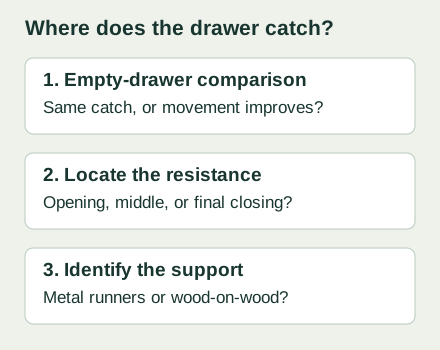
If it opens normally enough to reach inside, remove the contents and any loose organizer. Look for an item sticking above the sides, a liner caught at the back, or a screw or object lying in the opening. Inspect with a light without reaching into a moving mechanism. A trapped drawer is not an invitation to pull harder.
Move the empty drawer slowly with a centered pull. Record whether it catches immediately, in the middle, or near the closed position. Note scraping, a sideways shift, and any visible contact between the front and the cabinet. You do not need to reproduce the fault repeatedly once you can describe it.
Scroll across to read every column.
| Empty-drawer result | What it suggests checking next | What it does not establish |
|---|---|---|
| Movement improves after removing a tall organizer. | Check the organizer and its contents against the opening throughout travel. | That the slides need replacing. |
| It improves when emptied, but no object was touching. | Compare the intended contents with the product's load limits; inspect the box and supports for movement. | Overloading as the only possible cause. Load can expose a mounting or box problem. |
| The same catch remains at the same position. | Look for a repeatable contact point or a seating/mounting problem. | The identity of a failed part. |
| The front touches the neighboring front before closing. | Check front alignment and the drawer's attachment to its runners. | A lack of lubrication inside the slide. |
Enlarge diagram
Swipe across to see the rest of the diagram.
Identify the supporting system before removing the box
A wooden drawer box may ride on metal runners. Look for exposed ball-bearing slides at the sides, concealed runners below, rollers, or wood bearing directly on wood. Record a model number and photograph the attachments. Do not infer the release method from the material of the drawer front.
Accuride notes that some slide families disconnect and others remain attached. Its installation guidance requires correct, consistent side space and parallel mounting. These are useful checks when a drawer catches, but that page's example dimensions are not a prescription for every slide.
Remove the drawer only when you can identify its release instructions and support its weight. Do not loosen mounting screws merely to find out whether the drawer will come out.
A specific release example: Blum's R001/R002 TANDEM kit instructions show two orange locking-device handles underneath the front. For those kits, the handles are squeezed before the supported drawer is pulled straight out and up. The same document shows automatic locking engagement when reinstalling. Use that procedure only if the kit and fittings match; orange plastic alone is not identification.
For metal slides, look for contact and movement first
With the drawer supported and access provided by its instructions, inspect the exposed path for an obvious obstruction, a protruding fastener, a bent member, or an attachment pulling away from the cabinet. Photograph what you find before changing it. Keep fingers clear of bearing tracks and closing mechanisms.
A rail that moves against the cabinet when the box moves needs an attachment check. A cabinet front that rubs while the runners remain smooth needs an alignment check. A newly installed drawer that has always bound needs a comparison with the installation drawing. Use the existing measurement sheet if that comparison requires actual clearances; this diagnostic pass does not replace it.
If a loose item can be removed without dismantling the mechanism, remove it and repeat the empty-drawer check. For a loose attachment, damaged mounting material, or bent hardware, identify the required repair before operating under load. Adding a longer screw or bending a rail back is not a general repair procedure.
Do not start by spraying lubricant. Accuride Europe says its ball-bearing slides normally have enough lubrication for their service life, while some environments or cleaning may create a need for additional grease. Its recommendation in that situation is an EP-rated bearing grease. That is Accuride guidance, not permission to oil every roller, damper, plastic catch, or undermount system. Confirm care instructions for the exact product first.
For wood-on-wood contact, separate a seasonal change from damage
On a drawer that runs on wood, note where the contact occurs and whether the problem appeared after a humid period, a spill, or moving the furniture. Compare other drawers without swapping boxes between openings. A repeated rub mark is evidence of contact; it does not by itself tell you how much material, if any, should be removed.
Simpli Home explains that its solid-pine furniture exchanges moisture with the air and that expansion can make drawers stick. This supports considering humidity when the construction and timing fit. It does not explain every stiff drawer, and it should not be generalized into a promise that a water-damaged box will recover.
Record the room conditions and ask the furniture maker for the appropriate care range. Do not plane or sand a seasonal tight spot as the first experiment: removing wood is irreversible. Splits, a loose joint, a dropped bottom, or swollen composite board need a material-specific repair assessment. Apply wax or another treatment only if the maker permits it on that bearing surface; a finish-care product is not automatically a runner lubricant.
Retest the change, not several changes at once
After any permitted removal and reinstallation, verify the drawer is seated and secured according to its manual. On Blum's R001/R002 example, the front locking devices and rear runner hooks are part of the attachment system; consult the installation and insertion steps together. Do not load a drawer whose engagement is uncertain.
Check the empty drawer first. If it moves smoothly and remains secure, return the intended contents within the product's limits and check again. Record the contents, the catch location, and whether the original symptom returned. Do not put back an obviously obstructing or excessive load to prove the diagnosis.
If the symptom remains, send the cabinet maker or hardware supplier the model, attachment photos, where it catches, and what changed when emptied. That report is more useful than “the drawer is stiff.” If replacement is confirmed, continue with the replacement measurements. If only the handle is loose, use the pull replacement and screw-fit guide.
Record the hardware before choosing a replacement.
Open hardware measurement sheetSources
- Accuride Europe: Installing drawer slides ↗
parallel mounting, side-space consistency, disconnect and non-disconnect arrangements. Its generic setbacks and clearances are not reproduced as universal values.
- Blum: R001 & R002 TANDEM kit instructions ↗
©2025, PDF pages 4–5 and 9, steps 2–3 and 6 — rear hooks, front locking devices, insertion and release. Identified through the Blum US instruction library.
- Blum US instruction library ↗
- Accuride Europe: Do ball bearing drawer slides need to be lubricated? ↗
normal lubrication and conditional re-greasing.
- Simpli Home: How do humidity and heat affect wood furniture? ↗
updated May 17, 2022 — solid-pine moisture movement. The maker's numeric humidity range is not used as a universal target.